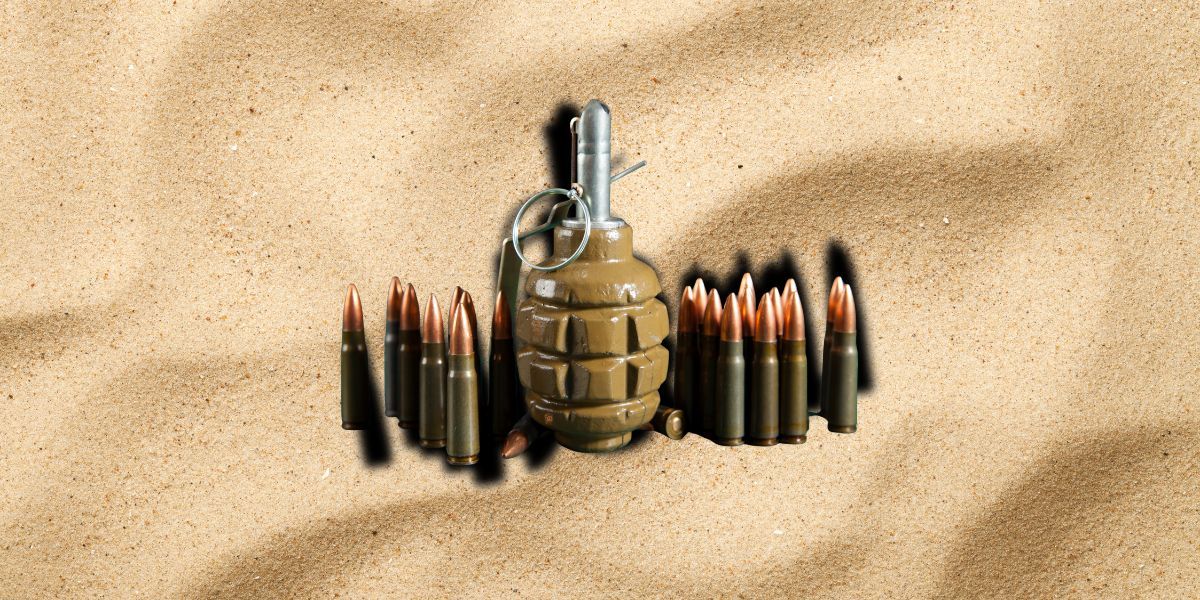
A World War II artillery shell found on a Sunshine Coast beach has been destroyed in a controlled blast that woke nearby residents before dawn.
The unexploded round was discovered just before midnight on Saturday at the base of a dune on Wurtulla Beach. Sean Mackney and a friend came across it while walking his dog. His friend called out that she thought she had found a bomb. Curious, Mackney picked the object up before he realised what it was.
“The sheer weight of it was massive,” he told the ABC. “I didn’t really know what to do … we called the police, and they were down there pretty quickly. I’m surprised nobody else had seen it, and [I wonder] how long it was exposed.”
Queensland Police attended and held the site until specialists from the Australian Defence Force’s Joint Explosive Ordnance Support South Queensland team arrived. Defence confirmed the item was a 25-pound high-explosive projectile, known as a 25-pounder, from the Second World War.
The shell weighed about 11 kilograms. Bomb disposal personnel assessed it on the beach and destroyed it there using standard procedures at about 4 am on Sunday.
The blast carried into nearby suburbs. Battery Hill resident Rhiannon McPherson said she was woken by “a massive bang.”
“I thought maybe a bad car accident or something … it sounded like something really big had dropped onto cement,” she said. “I was waiting to hear sirens but didn’t hear anything. I woke my husband, but he hadn’t heard it. My dog didn’t bark, which threw me off as well. I was trying to work out if I’d made it up or I’d dreamt it.”
No injuries were reported. Defence said the projectile was disposed of safely.

A large area north of Caloundra was set aside as an artillery range at the start of the Second World War. Australian and Allied forces used it between 1939 and 1944 for artillery, infantry and armour live firing.
Gun positions ran in a line along what later became the Nicklin Way, from Careen Street through to Browning Boulevard at Battery Hill. Training also took place in Currimundi and the country now built-out as Kawana. Defence still lists the Wurtulla area as having substantial potential for unexploded ordnance, and the stretch of coast from Dicky Beach to Bokarina has long shown up on national maps of wartime ranges.
Finds have continued as the coast has been developed. Earthworks crews working northern Caloundra and Kawana from the 1970s into the 1990s reported scores of rounds in the Currimundi and Wurtulla estates. In July 2009, a routine council sweep at Wurtulla turned up two unexploded shells in a single morning. Police said at the time it was not unusual for projectiles to be unearthed, and that every one had to be treated as live.
Storms, erosion and shifting dunes can bring buried rounds back to the surface years after the range closed. That is the most likely explanation for a shell sitting in the open at the foot of a dune on a Saturday night, on a beach that is walked every day.
The quick-firing 25-pounder was the main field gun of Commonwealth forces from the early years of the war into the 1960s. Australia began building the guns in 1942, including at General Motors-Holden, and the Army kept them in service until 1965, when it replaced them with the 105mm howitzer. A shorter, lighter Australian version was also made for jungle fighting in New Guinea.
The high-explosive projectile is about 30 centimetres long and roughly 88 millimetres across. It is fitted with a nose fuse and can contain between 450 and 900 grams of high explosive, often Amatol, a mix of TNT and ammonium nitrate. When fired, it weighed about 25 pounds, or 11.3 kilograms, matching the round destroyed at Wurtulla.
Defence says unexploded items of this type are most often found on or near old artillery practice areas, from the surface down to about 1.5 metres. A round that has been fired and failed to detonate is more dangerous than one that was never armed. The safety features that should have kept it inert have already been overcome, and even a small disturbance can set it off.
The Australian Defence Force’s explosive ordnance teams respond to about 500 unexploded ordnance calls a year, working with state and territory police. In December 2025, Defence said its teams had already answered more than 450 requests for support that year.
Recent jobs have included three Second World War bombs destroyed on a remote beach near Nhulunbuy in the Northern Territory in 2025, and a military explosive detonated at Ulladulla on the New South Wales South Coast in 2024. Most calls are for shells, mortars, grenades and markers found on former training grounds, in bushland, or washed up after weather.
Director General Explosive Ordnance, Commodore James Nash, said last summer that unexploded ordnance remains hazardous even decades later, and that anything unusual should be treated as live.
So if you find one do not touch or try to shift it somewhere “safer,” and do not bury it or throw it back into the water. Note the location, using landmarks or a pin, and leave the area. Call Triple Zero (000) and ask for police. Police will request Defence attendance.
Photographs can help identification, but only if you can take them without approaching or handling the object.
Anyone who discovers a suspected shell, grenade or bomb on a beach, in a dune, or during earthworks should treat it as live, even if it looks rusted, incomplete or decades old.